How to Tell If AI Automation Works for Compliance Teams
AI automation can take repeatable checks off compliance teams, but not accountability. See which tasks it handles reliably and how to measure real value.
Last Updated: 7 November 2026
Quick Summary
AI automation works for compliance teams on document-heavy tasks such as clause extraction, policy question answering and regulatory change tracking, where the answer already exists in a document. It does not replace human judgement, escalation or accountability, so most operations need manual review, rules-based automation and AI layered together.
- AI-powered compliance task automation reached $5.96 billion in 2026, up from $4.63 billion in 2025.
- 43% of large enterprises had integrated AI into GRC platforms, against 21% in 2023.
- False positives kill adoption faster than missed risks, so track your false-positive rate from week one.
- Pilot on one task and 50 real documents from the last twelve months, recording time and error rate by hand first.
- Agencies and integrators can whitelabel the Certant platform and keep implementation, support and integration revenue.
Table of Contents
- Does AI Automation Actually Work for Compliance Teams in 2026?
- AI in Compliance Use Cases: Where Automation Earns Its Place
- AI Risk Management: Monitoring, Flagging and Predicting
- How Compliance Automation Tools Compare with Rules and Manual Review
- Human Oversight in AI Compliance: What Stays with Your Team
- A Task-by-Task Suitability Matrix for Compliance Work
- How to Measure Whether It Works: Pilot Design and Verification
- Start Your Free Trial and Test It on Your Own Documents
- Frequently Asked Questions
Does AI Automation Actually Work for Compliance Teams in 2026?
Does AI automation work for compliance teams? Yes, for specific, document-heavy tasks. No, not as a replacement for judgement. That distinction is the whole argument, and most vendors blur it.
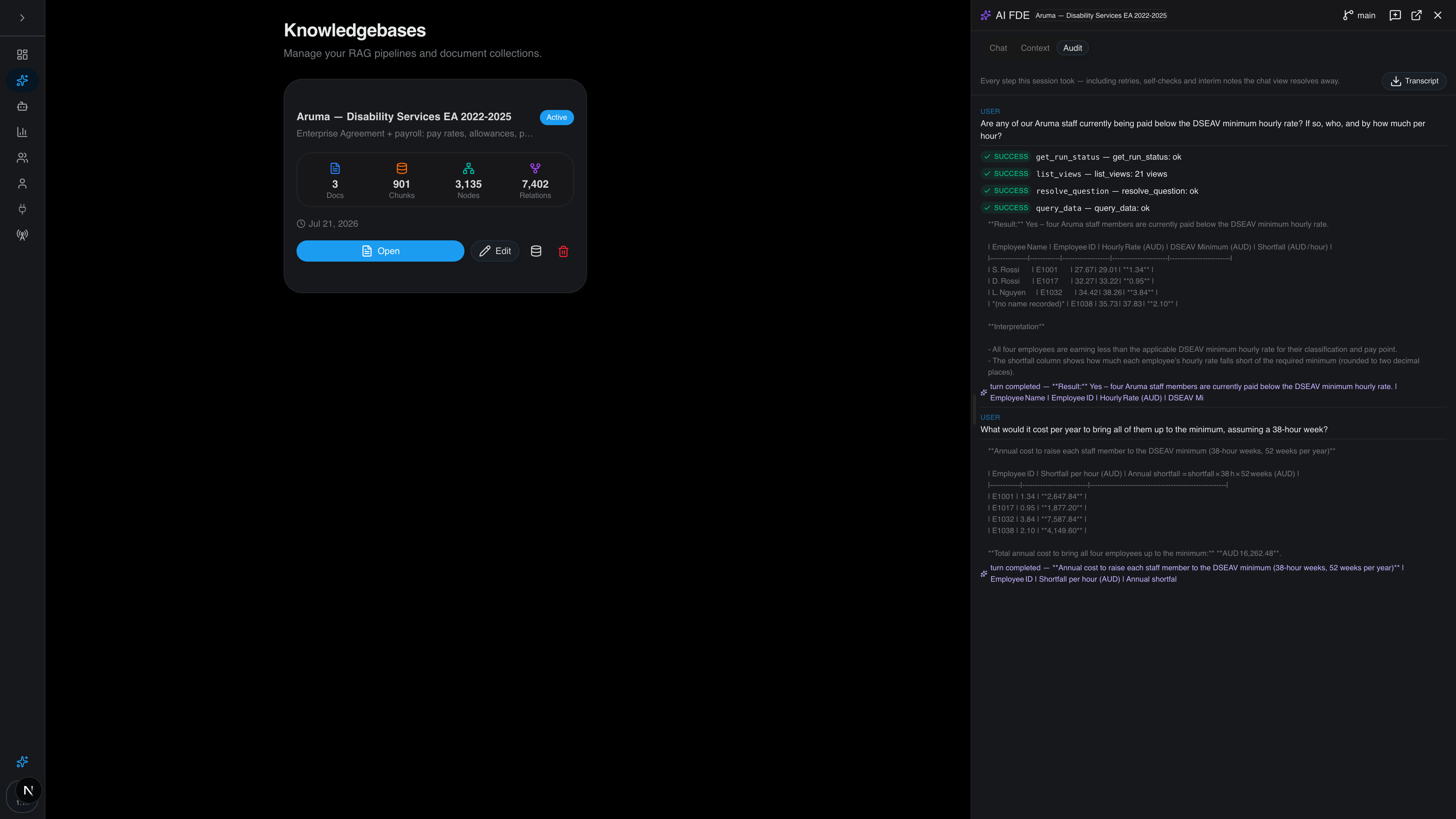
The market is voting with its wallet. The Business Research Company's market report puts AI-powered compliance task automation at $5.96 billion in 2026, up from $4.63 billion in 2025, with a projected $16.25 billion by 2030. Spending is real.
At Certant, we build for regulated teams, so we have a stake in the answer. For a direct look at which AI tools don't hallucinate and what separates the trustworthy ones, we set out the honest answer for regulated teams.
What the Evidence Says, and Where It Stops
Adoption is climbing faster than evidence. A summary of Gartner's 2025 Legal and Compliance Technology Trends report reports that 43% of large enterprises had integrated AI into GRC platforms, against 21% in 2023, with a 65% projection for 2027.
That is adoption, not outcomes. The two are not the same, and the research base for outcomes is thin.
- Most published figures measure deployment, not error rates.
- Few studies separate AI gains from process changes made alongside them.
- Vendor case studies rarely publish failure rates.
AI in compliance is best understood as a retrieval and flagging layer, not an autonomous decision-maker. Treat any claim of full autonomy with suspicion.
AI-powered compliance task automation market value
AI in Compliance Use Cases: Where Automation Earns Its Place
The strongest use cases share a trait: the answer already exists in a document. Automation finds it faster.
GSDC's 2026 analysis of compliance automation lists the tasks where the technology fits: data collection, control testing, transaction monitoring and reporting. All are repetitive. All have a checkable output.
Where it pays off first:
- Document review. Pulling clauses, dates and obligations from contracts.
- Policy management. Answering staff questions from approved documents.
- Regulatory change tracking. Mapping new rules to existing controls.
- Workflow automation. Assigning tasks and tracking due dates after a rule changes, as Compliance.ai's workflow guide describes.
The pattern holds. If a junior analyst could answer it by reading the right page, automation can probably help.
AI Risk Management: Monitoring, Flagging and Predicting
Risk work splits into three jobs, and automation handles them unequally. Monitoring is strong. Flagging is good. Prediction is the weakest of the three.
AI risk management works best when the system points at evidence rather than conclusions.
What we see in practice:
- Continuous monitoring of transactions and contracts is reliable when rules are explicit.
- Risk identification improves when the tool cites the source paragraph.
- Predictive insight needs clean historical data most teams do not have.
Watch out: false positives kill adoption faster than missed risks. If reviewers learn to ignore flags, the tool is worse than nothing. Track your false-positive rate from week one.
For a deeper look at frameworks and assessment methods, our AI risk management guide covers the full process.
How Compliance Automation Tools Compare with Rules and Manual Review
Three approaches, three different jobs. Picking the wrong one for a task is the most common mistake we see.
| Approach | Best for | Weakness | Setup effort |
|---|---|---|---|
| Manual review | Judgement calls, escalations, novel cases | Slow, inconsistent, expensive at volume | None |
| Rules-based automation | Fixed thresholds, date checks, mandatory fields | Breaks on anything unexpected | Medium |
| AI automation | Reading documents, extracting clauses, answering policy questions | Needs grounding and human review | Medium to high |
Rules-based tools fail silently when input changes shape. AI tools fail loudly, which is better, provided someone is watching.
The honest answer: most compliance operations need all three, layered.
Human Oversight in AI Compliance: What Stays with Your Team
Human oversight is not a checkbox. It is the control that makes the rest defensible.
Adaptive Security's 2026 guidance on AI compliance management makes the point directly: human-in-the-loop validation remains essential. Automation assists. People remain accountable.
What stays with your team:
- Approving anything that leaves the building.
- Judging context the documents do not capture.
- Investigating flagged anomalies.
- Signing off on regulatory submissions.
OneDigital's 2026 note on workplace AI compliance adds a legal point worth repeating: using AI does not exempt an employer from anti-discrimination, privacy or employee-protection obligations.
Auditability is where this becomes concrete. Our page on showing auditors where each AI answer came from explains how every question, passage and approval gets logged.
A Task-by-Task Suitability Matrix for Compliance Work
Not every task deserves automation. This matrix is the one we would use to triage a compliance backlog.

| Task | Automation fit | Why |
|---|---|---|
| Clause extraction from contracts | High | Answer sits on a page |
| Policy question answering | High | Source documents exist |
| Regulatory change mapping | Medium | Needs human confirmation |
| Control testing | Medium | Rules must be explicit |
| Breach investigation | Low | Context and intent matter |
| Regulatory submission sign-off | None | Accountability cannot be delegated |
Start at the top. Prove value there before moving down.
How to Measure Whether It Works: Pilot Design and Verification
Most pilots fail because they measure the wrong thing. Speed is easy to measure and easy to game. Accuracy is harder and matters more. A pilot that actually answers the question has to produce a number you would be willing to show an auditor, not just a slide for the steering committee.
Design the pilot around one task and a fixed document set
- Pick one task and 50 real documents, drawn from the last twelve months so the formats match what the team sees now.
- Record your current time and error rate by hand on those same 50. Do this before the tool is switched on, not after.
- Run the same 50 through the tool with the same instructions a reviewer would give a junior analyst.
- Check every output against the source document, line by line, and record where the answer came from.
- Count false positives, missed items and refusals as three separate numbers. They fail in different ways and need different fixes.
- Have a second reviewer independently sign off on a sample of 20, without seeing the first reviewer's marks.
- Compare time, accuracy and reviewer workload, and record the variance between the two reviewers as well as the mean.
Refusal behaviour matters as much as accuracy. A tool that says "I cannot find this in the documents" is more trustworthy than one that guesses. Our guide to testing document AI before trusting answers sets out the full method, including refusal tests and citation checks.
Set the pass mark before you start
Decide now what error rate you would accept, and stick to it. A pass mark set after the results arrive is not a pass mark. Three thresholds are worth agreeing in advance:
- Missed-item rate. The share of required items the tool failed to surface. This is the number that creates regulatory exposure.
- False-positive rate. The share of flags a reviewer rejected. This is the number that destroys adoption, because reviewers learn to ignore a noisy tool faster than they learn to trust a quiet one.
- Refusal rate. The share of questions the tool declined to answer. A high refusal rate is not a failure by itself, but it tells you the document set or the prompts need work before the tool is useful at volume.
A common pattern is a tool that scores well on missed items and badly on false positives. That combination is often acceptable for a first-line triage tool and unacceptable for anything a reviewer relies on without checking. That distinction matters beyond triage, because AI contract risks also arise when teams rely on automated assessments without a reviewer checking what the system has flagged.
Handle the failure modes explicitly
A pilot that does not test failure handling is testing the demo, not the product. Four failure modes need a written answer before go-live.
- Hallucination. The tool states something the document does not say. The control is citation to a source paragraph, checked on every output during the pilot, not just sampled.
- Silent model change. The vendor updates the model and behaviour shifts. Ask for a change log and a re-test clause, and re-run the 50-document set after any update.
- Stale source documents. The tool answers from a superseded policy. The control is a document version check at retrieval time, not a periodic manual review.
- Reviewer over-reliance. The reviewer stops checking because the tool is usually right. The control is a periodic blind re-check of a sample, with the tool's answer hidden.
Keep the evidence
Every pilot output, reviewer sign-off and source citation should be retained in a form an auditor can follow. That means logging the question asked, the passages retrieved, the answer given, the reviewer who approved it and the timestamp.
Watch out: a pilot that passes on accuracy but cannot show its working will fail the audit conversation, and the audit conversation is the one that matters.
Start Your Free Trial and Test It on Your Own Documents
The only test that counts is your documents, your policies and your reviewers.
Certant builds a live knowledge graph from your internal documents and returns answers with citations to the source paragraph. Our agents handle the boring work: scoring incoming contracts against CPS 230, APP 8 and your own policies, flagging the clause that matters and the page it sits on.
Agencies and integrators can whitelabel the platform and keep implementation, support and integration revenue. If you are building compliance products for clients, our Whitelabel AI Platform is designed to be resold under your own brand, with Custom AI Agents tailored to each client's policies and document set.
Get started with Certant and see what your own contracts say back to you.
Compliance teams are being asked to prove value, not just buy tools. The ones who get this right run small, measured pilots and keep accountability where it belongs.
Frequently Asked Questions
How can compliance teams verify AI-generated answers?
The answer has to come back with its source attached. A system that cites the paragraph it drew from lets a reviewer click through to the original policy, contract clause or regulation and check it in seconds. Certant builds a live knowledge graph from your documents and returns answers with citations to source paragraphs, so verification is a reading task rather than a trust exercise. Ask any vendor to show you this on your own files before you sign.
Which compliance tasks are suitable for AI automation?
Document-heavy, repetitive work suits automation best: first-pass contract review, policy Q&A, regulatory change tracking, control testing evidence collection and case triage. Judgement-heavy work does not. Deciding whether to report a breach, signing off an exemption or setting risk appetite stays with a named person. The practical split is tasks where the answer already exists somewhere in your records versus tasks where someone has to weigh consequences.
Will compliance jobs be replaced by AI?
Not on the evidence available. Adoption is rising, but human-in-the-loop validation remains essential. The shift is in task mix rather than headcount: less time reading and collating, more time on exceptions and decisions. Teams that adopt early tend to redeploy people onto the work that actually needs a qualified judgement.
How can AI automation keep compliance records traceable for auditors?
Traceability comes from the audit trail, not the model. Every automated action should record what was read, what was flagged, who reviewed it and what they decided. Certant's knowledge graph keeps the link between an answer and its source paragraph, and supports sovereign, air-gap-capable and on-premisess deployments so records stay inside your environment. Test this in a pilot: pick one flagged item and ask the vendor to reconstruct the full chain from source document to decision.