Which AI tools don't hallucinate? An honest answer for regulated teams
No AI tool is free of hallucination. What separates the trustworthy ones is grounding in your documents, passage-level citations and refusing when the answer isn't there.
No AI tool that writes its own answers is free of hallucination, and any vendor who tells you otherwise is selling you something you can't audit. What you can buy is a tool that answers only from your own documents, shows you the passage each answer came from, and says "I can't find that" when the passage doesn't exist. Those three behaviours turn a hallucination from something you discover in front of a client into something you catch in a second.
I build one of these tools, so read the rest with that in mind. I've tried to keep the evidence to things you can check yourself.
What the measurements say
The cleanest public measurement is Vectara's hallucination leaderboard. It hands each model a news article and asks for a summary using only the facts in that article, which is the easiest job a grounded system ever gets. In the May 2026 update the best model added unsupported claims to 1.8% of its summaries. Well-known models from OpenAI, Anthropic, Google, Meta and Alibaba sat anywhere from about 3% to over 20%. That's with the source document sitting right in front of the model.
Specialist tools don't escape it either. In 2024, Stanford's RegLab and HAI tested the legal research assistants whose vendors had marketed them as "hallucination-free" or as avoiding hallucinations. They found Lexis+ AI and Ask Practical Law AI gave incorrect information more than 17% of the time, and Westlaw AI-Assisted Research more than 34%. Those tools retrieve from curated legal databases. Retrieval cut the error rate a long way below general chatbots, which an earlier study put at 58% to 82% on legal questions, but it didn't get anywhere near zero. The full paper was published in the Journal of Empirical Legal Studies in 2025.
So the useful question for a buyer is a different one: when this tool gets something wrong, how quickly will a person notice?
What it costs when nobody checks
In July 2025 a University of Sydney academic, Dr Christopher Rudge, noticed that a A$440,000 report Deloitte had written for the Department of Employment and Workplace Relations cited academic reports that didn't exist and quoted a Federal Court judgment that said no such thing. Deloitte disclosed that a GPT-4o-based tool chain had been used, corrected the report and agreed to repay the final instalment of the contract.
In February 2024, British Columbia's Civil Resolution Tribunal held Air Canada responsible for a bereavement-fare refund policy that the chatbot on its website had invented. The airline argued the chatbot was responsible for its own words. The tribunal didn't accept that.
Neither case needed a smarter model. In both, a reader had no quick way to see where a sentence came from, so a fabricated sentence looked exactly like a sourced one.
Six checks that separate grounded tools from guessing ones
When people ask me which tools don't hallucinate, I give them this list instead. Every item can be tested in a trial, before a contract.
| Check | What to ask the vendor | How to test it yourself |
|---|---|---|
| Answers come from your documents | Does the answer draw only on the sources I connected, or can the model fill gaps from its training? | Ask something your documents contradict, such as a leave entitlement that differs from the national standard. A grounded tool gives your number. |
| Citations point to the passage | Does a citation open the document at the paragraph, or only link the file? | Click ten citations. Count how many land on text that supports the sentence. |
| It says when it can't find something | What happens when the documents don't hold an answer? | Ask five questions you know aren't covered. Any confident answer is a failure. |
| Numbers come from the table | Are figures from tables read and calculated, or written by the model? | Ask for a rate from a scanned schedule and check it against the page. |
| Permissions carry through | Does the assistant respect the access rules in SharePoint, Drive or Confluence? | Ask as a user who can't open the source file. The answer should not appear. |
| There's a record | Is every question, source and answer logged, and for how long? | Ask for last week's log of your own trial questions. |
The third check is the one most demos skip, because a tool that says "I can't find that" looks worse in a sales meeting than one that always answers. In regulated work it's the most valuable behaviour on the list.
How the main kinds of tool do on those checks
General chat assistants such as ChatGPT, Gemini and Claude answer from what the model learned in training unless you give them documents or switch on search. With search on, they cite web pages, and the citation usually supports the sentence, but nothing stops the model from writing a sentence no source supports. They're excellent for drafting and poor as a system of record.
Enterprise search assistants, such as Glean, Microsoft 365 Copilot and Google's Gemini Enterprise, connect to your company's applications and answer with links to the documents they used. They pass the first two checks in most cases. Where they differ is in how specific the citation is, how firmly they refuse, and where the model runs. Most run on a hosted model in the vendor's or a hyperscaler's cloud, which matters if your documents can't leave the country.
Domain research tools in law, tax and medicine retrieve from curated databases and do better than general chatbots, but the Stanford numbers show that a curated database doesn't remove the problem.
Document-grounded platforms, which is the category Certant is in, are built around the checks above: they read your own files, including scans and tables, and answer only from them. They're narrower than a general assistant. They won't write you a poem.
What Certant does, and what we don't claim
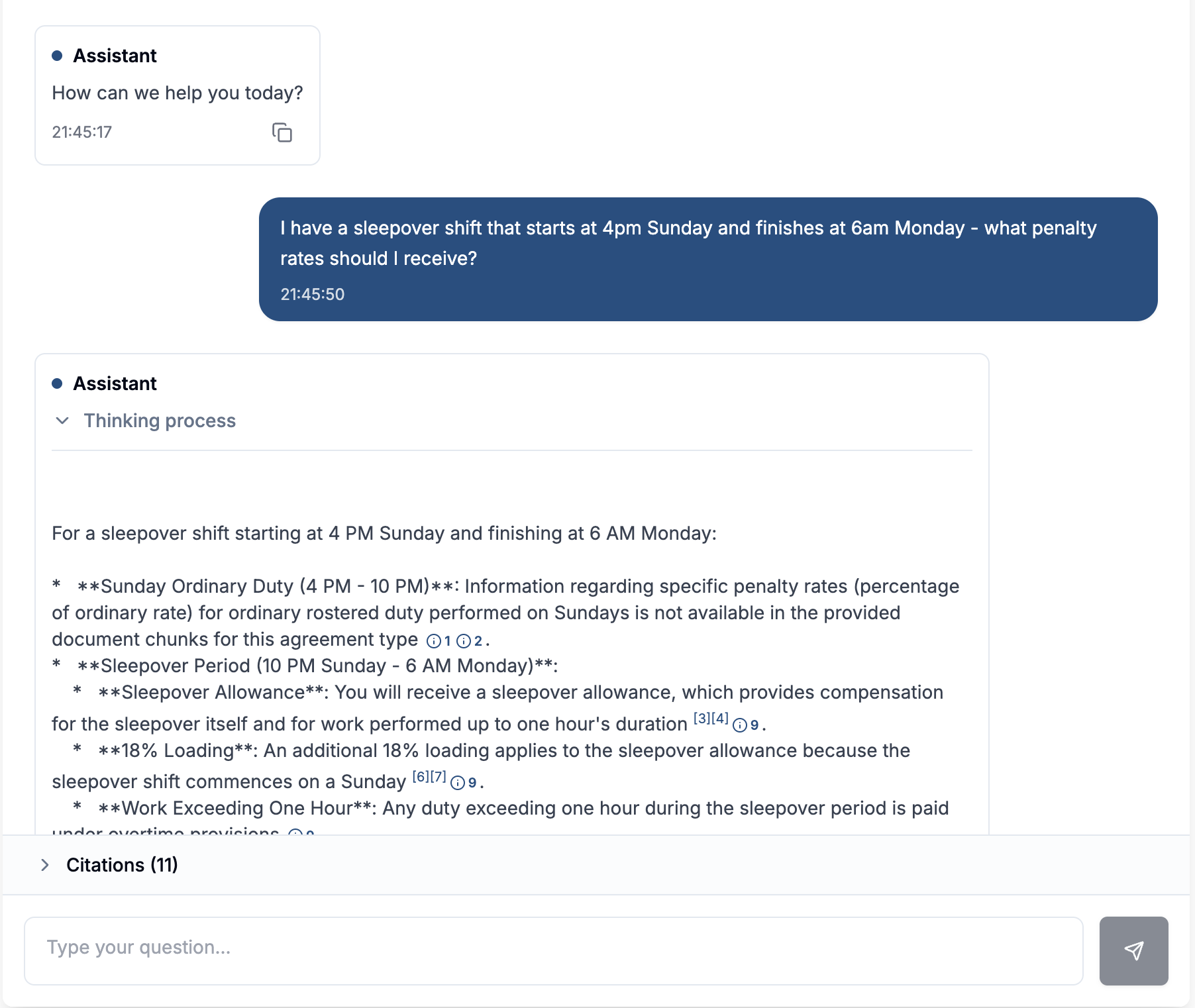
Every Certant answer carries a citation, and one click opens the source at the paragraph it came from. When the documents don't cover a question, the chatbot says so and offers to pass it to a person. The screenshot below is a member assistant we built for a union. Asked about a Sunday sleepover shift, it answered the parts the enterprise agreement covers, cited them, and said plainly that the Sunday ordinary-duty rate wasn't in the documents it could read.
For numbers, Strata reads the tables inside documents into data and answers with SQL, so the figure is computed rather than written. If the question needs data the documents don't hold, you get a "No matching data model" card instead of a number. I wrote about that refusal in Ask your data in English, get governed SQL or an honest no.
We don't claim Certant never hallucinates. A model still writes the sentences, and a sentence can still drift from its source. In my experience most wrong answers start earlier, when a document is read badly. A missed table row is invisible to every check in the list above. Two posts cover that in detail: asking for JSON halved our extraction recall, and missing tables, not the extraction model, explained our accuracy gap.
A one-hour test before you buy anything
You can run this on any tool with a free trial, including ours.
- Load 20 to 50 real documents, including at least one scanned PDF with a table.
- Write 20 questions you already know the answers to, and 5 you know the documents can't answer.
- Ask all 25. Mark each answer right, wrong, or "said it couldn't find it".
- Click every citation on the right answers and confirm it supports the sentence.
- Repeat three questions as a user who shouldn't see the source.
A tool worth trusting gets the 5 unanswerable questions right by declining them. If it invents answers to those, the other 20 don't matter much. There's a longer version of this method in How to test document AI before trusting its answers, and you can run it on Certant with the free trial, which covers about 50 pages or 100 questions.
Frequently asked questions
Is there an AI that never hallucinates?
No. Every tool that generates text can produce a sentence its sources don't support. On Vectara's May 2026 summarisation test the best model still did it in 1.8% of summaries. Choose a tool that cites the passage behind each answer and declines when no passage exists, so errors are easy to catch.
Does retrieval-augmented generation (RAG) stop hallucinations?
It reduces them a lot but doesn't stop them. Stanford's 2024 study of retrieval-based legal research tools still found error rates between 17% and 34%. Retrieval works best combined with passage-level citations, refusal when nothing relevant is retrieved, and accurate reading of tables and scans.
Which AI tools are safest for regulated industries?
Tools that answer only from your approved documents, cite the paragraph, refuse when the documents are silent, respect source permissions and keep an audit log. If your data can't leave Australia or your network, also check where the model runs. Certant can run in its own cloud, in your cloud account, or fully air-gapped; see how each option works.