Enterprise AI Implementation Cost and Timeline Guide
Enterprise AI implementation cost and timeline explained: what drives budgets, how long rollouts take, and what regulated teams should plan for. Start.
Table of Contents
- What Enterprise AI Implementation Cost and Timeline Really Look Like in 2026
- Why AI Implementation Challenges in Regulated Industries Change the Numbers
- The Main Cost Drivers Behind Enterprise AI Implementation
- The Hidden Costs of Enterprise AI No One Budgets For
- Data Infrastructure Requirements for AI: The Prerequisite Most Teams Underestimate
- Building a Realistic Enterprise AI Project Roadmap
- How to Calculate ROI Without Inflating the Business Case
- Common Mistakes That Blow Out Enterprise AI Implementation Budgets and Timelines
- Frequently Asked Questions
Last Updated: 20 September 2026
What Enterprise AI Implementation Cost and Timeline Really Look Like in 2026
Enterprise AI implementation cost and timeline planning starts with one uncomfortable truth: the licence fee is the smallest number on the page. Organisations often budget carefully for software and then get blindsided by the work around it. Data cleanup, integration, governance sign-off and staff training routinely outweigh the platform subscription.
That is not a reason to avoid the project. It is a reason to plan it properly.
The pattern is consistent across regulated sectors. Teams that map their data before they sign a contract move faster and spend less. Teams that buy first and investigate later stall in month four, when the pilot meets real documents.
Below, we break down the actual cost drivers, the hidden line items, and a phased roadmap you can take to your finance team. The figures here are structural, not quoted prices, because every deployment differs.
Why AI Implementation Challenges in Regulated Industries Change the Numbers
AI implementation challenges in regulated industries are fundamentally different from those in unregulated ones, because every answer the system produces may need to be defended to an auditor. That single requirement reshapes the budget.
A general-purpose assistant can be deployed quickly. A system that touches contracts, policy documents or patient records cannot. Someone has to define what counts as a source of truth, who approves it, and how a decision is traced back to a paragraph.
In practice, this means regulated deployments carry three costs that others do not:
- Evidence and traceability. The system must show its working. Retrofitting citations onto a model that was never built for them is expensive.
- Access control. Different staff see different documents. Permissions must be enforced at the answer level, not just the folder level.
- Change management. Compliance and legal teams need to sign off before rollout, and that review takes calendar time, not engineering time.
The timeline impact is real. A pilot that takes weeks elsewhere can take a quarter here, mostly waiting on governance rather than code.
The Main Cost Drivers Behind Enterprise AI Implementation
The two largest budget lines in most enterprise AI implementation projects are licensing and integration effort, and they behave very differently. Licensing is predictable and recurring. Integration is lumpy, front-loaded, and the place where estimates usually fail.
Licensing and Platform Fees
Licensing scales with users, documents, or both, and the model you choose matters more than the headline rate. Seat-based pricing looks cheap until half the organisation needs occasional access. Volume-based pricing looks expensive until you realise occasional users cost nothing extra.
Ask three questions before comparing any vendor:
- Does the price scale by named user, active user, or document volume?
- What happens to cost when you double your document corpus?
- Are there separate charges for connectors, storage or support tiers?
Certant publishes its pricing openly. You can see the model and start free before committing budget.
Integration and Deployment Effort
Integration is where the money actually goes. Connecting a platform to SharePoint, a case management system and a legacy database is not one task; it is three, each with its own access model and data quality problems.
A common mistake is scoping integration as a single line item. Break it into connectors, identity and permissions, data mapping, and testing. Each has a different owner and a different failure mode.
Build a brain for your company →
Deployment location also shifts the number. Cloud deployment is faster to stand up. Sovereign, air-gapped or on-premisess deployment costs more upfront but is often non-negotiable for government and financial services work.
The Hidden Costs of Enterprise AI No One Budgets For
The hidden costs of enterprise AI cluster around people and process, not technology. They rarely appear in a vendor proposal because the vendor does not own them.
Four line items catch teams out:
- Document remediation. Old PDFs, scanned contracts and inconsistent naming conventions all have to be cleaned before they are useful. This is often the largest single unplanned cost.
- Internal engineering time. Someone from your team has to be available for integration, testing and troubleshooting. That is time not spent on the day job.
- Ongoing evaluation. Answers drift as documents change. Someone needs to check quality periodically, which is a recurring commitment, not a one-off.
- Training and adoption. Staff need to trust the system before they use it. That takes sessions, champions and a feedback loop.
The remediation point deserves emphasis. A knowledge system is only as good as what you feed it, and most organisations underestimate how messy their archive is until they look.
Data Infrastructure Requirements for AI: The Prerequisite Most Teams Underestimate
Data infrastructure requirements for AI are the gating factor on your entire timeline. If your documents live in three systems with no consistent metadata, no amount of vendor capability will fix it on day one.
The prerequisite is not a data warehouse. It is clarity about four things:
- Where the documents are. Every source system, including the filing cabinet.
- Who owns each source. A named person, not a department.
- What the access rules are. Who is allowed to see what, and why.
- What "current" means. Which version of a policy is authoritative.
Get those four answers in writing and the integration phase becomes a build task. Skip them and it becomes a discovery project that runs indefinitely.
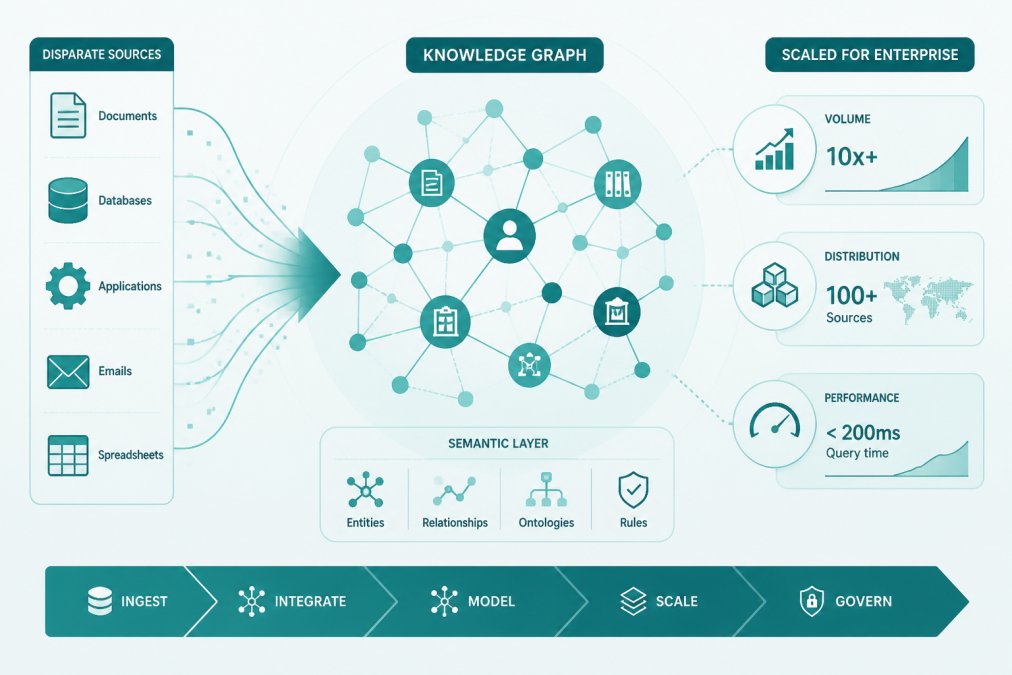
This is the stage where a knowledge graph approach earns its place. Rather than treating documents as isolated files, it maps the relationships between them, so an answer can cite the specific paragraph it came from. For regulated firms, that traceability is the difference between a tool staff trust and one they quietly ignore.
Building a Realistic Enterprise AI Project Roadmap
An enterprise AI project roadmap should be phased, with a hard decision point after each stage. The goal is to spend small before you spend big, and to learn something concrete at every step.

Phase 1: Scoping and Data Assessment
Scoping answers one question: is our data good enough to start? Expect this phase to take the longest relative to visible output, because the deliverables are documents, not software.
Outputs from this phase: a source inventory, an access map, a prioritised use case, and a data quality assessment. If the assessment comes back poor, that is a useful result. You have found the problem before it found your budget.
Phase 2: Pilot and Validation
The pilot should be narrow and real. Pick one workflow, one document set and one team. The measure of success is not "did it work" but "did the answers hold up under scrutiny".
Validation matters more than speed here. Have the compliance team test edge cases deliberately. Ask the system for an answer you know is wrong and see what it does.
Phase 3: Rollout and Scaling
Rollout is where adoption is won or lost. Start with the teams who asked for it, publish early wins, and expand once the support load is understood.
Build a brain for your company →
Certant's no-install, low-risk implementation process is designed for this stage. Because it works with existing cloud providers or local GPUs, scaling does not require rebuilding the environment each time you add a team.
| Phase | Typical Duration | Main Cost | Key Milestone |
|---|---|---|---|
| Scoping and data assessment | 4-8 weeks | Internal time | Data quality sign-off |
| Pilot and validation | 6-12 weeks | Licensing plus integration | Compliance approval |
| Rollout and scaling | 3-6 months | Licensing plus training | Adoption targets met |
Timelines vary by organisation size, number of source systems and how much remediation the archive needs.
How to Calculate ROI Without Inflating the Business Case
ROI calculations for enterprise AI fail in one of two directions: wildly optimistic or so cautious the project never starts. The useful version sits between them and counts time, not just money.
Start with the manual process you are replacing. If a contracts team spends hours reviewing each agreement, that is your baseline. Measure it honestly, including the review that gets escalated and the one that gets rechecked.
Then apply three tests:
- Does the saving recur? A one-off time saving is not ROI; a weekly saving is.
- Does quality improve or just speed? Faster wrong answers cost more than slow right ones.
- What is the risk reduction worth? For regulated firms, fewer missed clauses has a value that is hard to quantify but easy to defend.
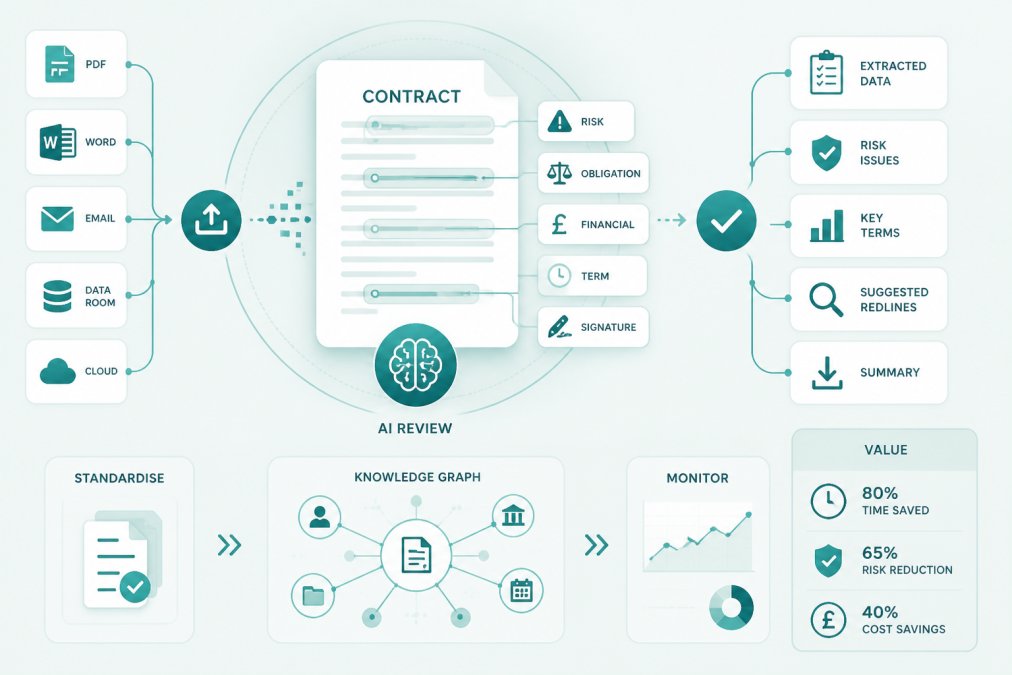
Certant's automatic risk flags on incoming contracts are a good example of a benefit that shows up in both columns: time saved in review, and risk reduced by catching what a tired reviewer might miss.
Be conservative on adoption in year one. Assume a ramp, not a switch.
Common Mistakes That Blow Out Enterprise AI Implementation Budgets and Timelines
Budget blowouts follow a small number of repeatable patterns. Recognising them early is cheaper than fixing them late.
- Buying before mapping. Signing a contract before you know your sources guarantees rework.
- Piloting on the hardest use case. Start narrow and real, not broad and impressive.
- Ignoring governance lead time. Legal and compliance review is calendar time you cannot compress.
- Underestimating remediation. Dirty documents are the quiet budget killer.
- Skipping the evaluation loop. Without periodic quality checks, trust erodes and adoption stalls.
The throughline across all of these is sequencing. Cost and timeline are not fixed properties of AI projects; they are consequences of the order in which you do things.
The hard part of enterprise AI is rarely the model. It is the data underneath it, the governance around it, and the patience to sequence the work properly. Certant was built for exactly this problem: a platform that turns fragmented documents into a verifiable knowledge graph, with answers cited back to source paragraphs, support for sovereign and air-gapped deployment, and compatibility with AWS Bedrock, Azure AI, GCP Vertex or local GPUs. Start free and see how your own documents hold up before you commit a budget.
Frequently Asked Questions
How long does it take to implement enterprise AI?
Most enterprise AI implementation projects run through three phases: scoping and data assessment, a pilot on a defined use case, and wider rollout. The pilot phase is usually the fastest to show value, while rollout depends on how many systems and teams are involved. Platforms with no-install, low-risk onboarding shorten the front end considerably, but regulated firms should still budget time for audit and compliance review before going live.
What are the primary cost drivers for enterprise AI projects?
Licensing and platform fees are the visible line item, but integration effort, data preparation, and internal staff time usually carry more weight. In regulated industries, add audit trails, access controls, and sovereign or on-premisess deployment requirements. The hidden costs of enterprise AI, such as retraining staff and maintaining data pipelines, are the ones that most often push a project past its original budget.
How does data preparation affect AI implementation costs?
Data infrastructure requirements for AI are where budgets quietly expand. Documents scattered across SharePoint, legacy case management systems, and shared drives need to be unified, deduplicated, and made verifiable before an AI system can answer questions reliably. The cleaner your source data and the fewer systems involved, the less preparation work you pay for. A live knowledge graph built from existing documents reduces this burden compared with rebuilding a data warehouse first.
Why do enterprise AI projects often exceed their initial timelines?
Scope creep, underestimated data preparation, and slow security or compliance sign-off are the usual culprits. Teams also forget the time needed to train staff on a new system and to validate outputs before trusting them. Setting a narrow first use case, such as contract risk flagging, and expanding only after the pilot proves out keeps the enterprise AI project roadmap on schedule rather than spiralling.
Frequently asked questions
How long does it take to implement enterprise AI?
Most enterprise AI implementation projects run through three phases: scoping and data assessment, a pilot on a defined use case, and wider rollout. The pilot phase is usually the fastest to show value, while rollout depends on how many systems and teams are involved. Platforms with no-install, low-risk onboarding shorten the front end considerably, but regulated firms should still budget time for audit and compliance review before going live.
What are the primary cost drivers for enterprise AI projects?
Licensing and platform fees are the visible line item, but integration effort, data preparation, and internal staff time usually carry more weight. In regulated industries, add audit trails, access controls, and sovereign or on-premisess deployment requirements. The hidden costs of enterprise AI, such as retraining staff and maintaining data pipelines, are the ones that most often push a project past its original budget.
How does data preparation affect AI implementation costs?
Data infrastructure requirements for AI are where budgets quietly expand. Documents scattered across SharePoint, legacy case management systems, and shared drives need to be unified, deduplicated, and made verifiable before an AI system can answer questions reliably. The cleaner your source data and the fewer systems involved, the less preparation work you pay for. A live knowledge graph built from existing documents reduces this burden compared with rebuilding a data warehouse first.
Why do enterprise AI projects often exceed their initial timelines?
Scope creep, underestimated data preparation, and slow security or compliance sign-off are the usual culprits. Teams also forget the time needed to train staff on a new system and to validate outputs before trusting them. Setting a narrow first use case, such as contract risk flagging, and expanding only after the pilot proves out keeps the enterprise AI project roadmap on schedule rather than spiralling.