Glean vs Stardog for Knowledge Management in 2026
Glean vs Stardog for knowledge management: compare search, graphs and governance, plus a regulated-industry alternative with verifiable answers.
Table of Contents
- Glean vs Stardog for Knowledge Management: The Short Answer
- Glean vs Stardog: Side-by-Side Comparison
- Glean: Pros and Cons for Knowledge Management
- Stardog: Pros and Cons for Knowledge Management
- Enterprise Knowledge Graph Platforms: What to Evaluate Before You Buy
- Knowledge Graph Use Cases That Decide the Purchase
- Where Enterprise Knowledge Management Software Breaks Down in Regulated Firms
- Knowledge Management Strategy for Remote Teams: Getting Answers to People Wherever They Work
- Which One Should You Pick?
- Frequently Asked Questions
Last Updated: 7 October 2026
Glean vs Stardog for Knowledge Management: The Short Answer
Choosing between Glean vs Stardog for knowledge management comes down to one question: do you need a search layer that sits on top of your existing tools, or a data layer that unifies structured records into a queryable graph? Glean is built for the first job. Stardog is built for the second. Certant sits closer to Stardog's territory, but with a narrower focus on regulated document workflows and verifiable answers.
The distinction matters more than most comparison pieces admit. A knowledge graph platform and an enterprise search tool solve different problems, and buying the wrong one leaves you with a system nobody trusts.
Below, we break down where each platform fits, what enterprise knowledge graph platforms actually need to do, and how to decide without wasting a procurement cycle.
Glean vs Stardog: Side-by-Side Comparison
Glean and Stardog overlap in the word "knowledge" and not much else. Glean indexes content across SaaS tools and returns ranked results. Stardog models entities and relationships, then answers structured queries against them.

| Capability | Glean | Stardog |
|---|---|---|
| Primary function | Enterprise search and discovery | Knowledge graph and data virtualisation |
| Data model | Document and content index | Entity-relationship graph |
| Best for | Finding internal content fast | Linking structured records across systems |
| Deployment | Cloud-first | Flexible, including on-premise options |
| Answer traceability | Source links | Query-level lineage |
| Regulated-industry fit | Moderate | Stronger on data governance |
For teams evaluating enterprise knowledge management software, the table above is the fastest filter. If your bottleneck is "nobody can find the policy," Glean addresses that directly. If your bottleneck is "we cannot reconcile the same customer across four systems," Stardog is closer to the answer.
Neither platform was designed around document-heavy compliance workflows. That gap is where a purpose-built knowledge graph platform earns its place.
Glean: Pros and Cons for Knowledge Management
Glean's strength is speed of adoption. It connects to the tools your staff already use and surfaces answers without asking them to change habits. For organisations with scattered content and no central index, that is a genuine win.
Pros:
- Fast deployment across common SaaS connectors
- Strong natural-language search across documents and messages
- Minimal training burden for end users
Cons:
- Search results depend on what was indexed, not what is correct
- Limited support for structured, relational queries
- Traceability stops at the document, not the paragraph
The last point is the one that bites in regulated settings. A search result that points to a 40-page policy document is not the same as an answer that cites the exact clause. Knowledge management professionals at large enterprises tend to discover this distinction during their first audit.
Stardog: Pros and Cons for Knowledge Management
Stardog treats knowledge as data. It builds a graph from your systems and lets you query relationships directly, which suits organisations with complex, interconnected records.
Pros:
- Handles structured and semi-structured data in one model
- Strong query capability for relational questions
- Deployment flexibility including on-premise options
Cons:
- Requires graph modelling expertise to implement well
- Steeper learning curve for non-technical staff
- Less suited to ad-hoc document search
What most guides miss is the implementation cost. A knowledge graph is only as good as the ontology behind it, and building that ontology is specialist work. Teams without that skill set often stall after the pilot.
Enterprise Knowledge Graph Platforms: What to Evaluate Before You Buy
Enterprise knowledge graph platforms are systems that model entities, relationships, and source documents into a queryable structure, then return answers with traceable provenance. That definition should drive your evaluation criteria.
Five things to test before signing anything:
- Traceability. Can the platform show the exact source paragraph behind an answer?
- Deployment fit. Does it support sovereign, air-gapped, or on-premise requirements?
- Ontology support. Does it help build the model, or expect you to arrive with one?
- Integration breadth. Does it connect to your document stores and line-of-business systems?
- Audit readiness. Can an auditor follow the reasoning from question to answer?
Certant builds its knowledge graph directly from internal documents and data, then returns answers with citations to source paragraphs. For regulated firms, that traceability is the difference between a tool staff trust and one they route around.
Knowledge Graph Use Cases That Decide the Purchase
Knowledge graph use cases fall into three practical categories: finding answers, automating decisions, and proving compliance. Each one demands a different level of traceability.
The first category is straightforward. Staff ask a policy question and get a cited answer instead of emailing a colleague. One Certant customer described it plainly: members used to save their weekend questions for Monday and ring in. The chatbot answers them straight away now, so Monday mornings are quieter.
Build a brain for your business →
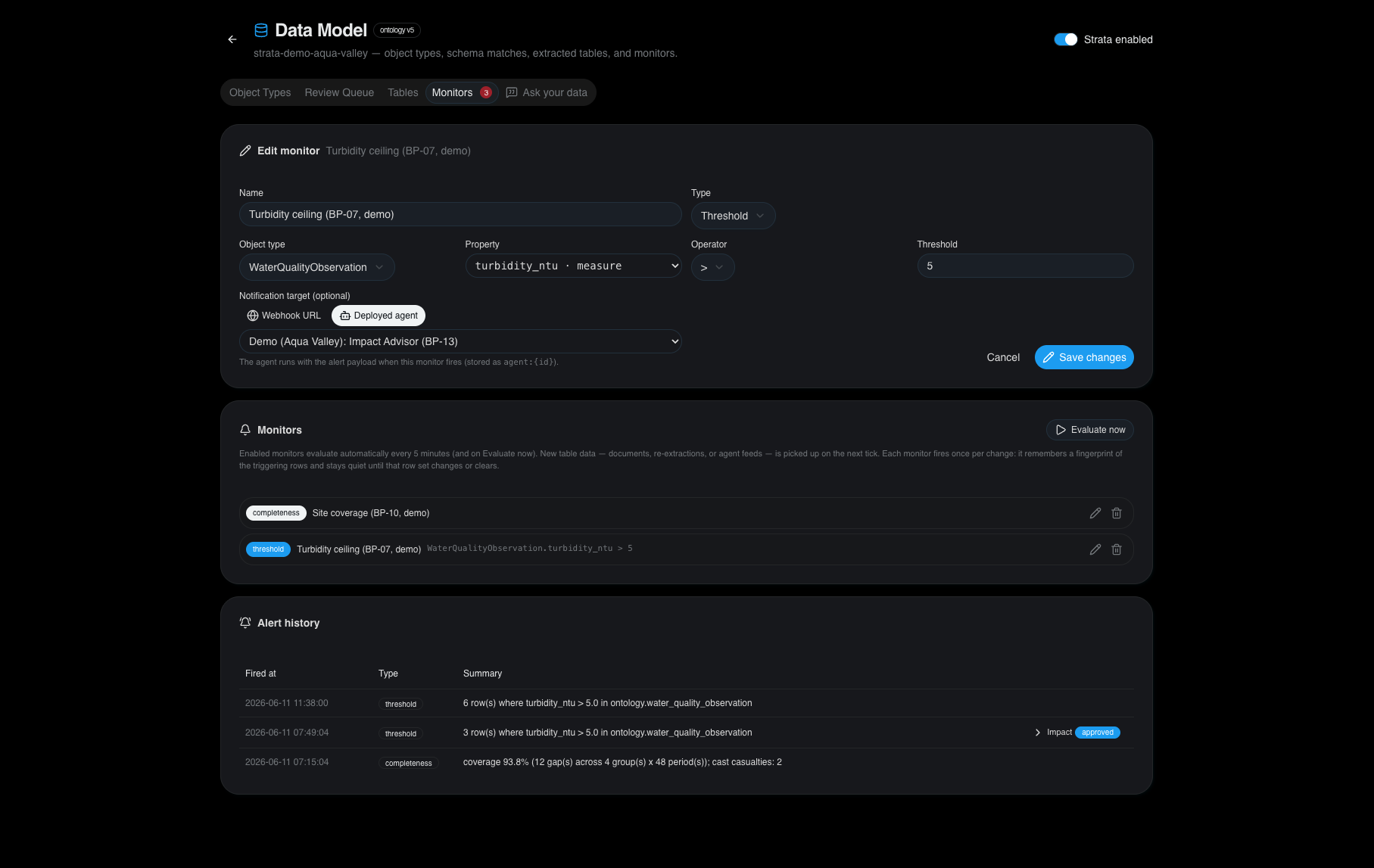
The second category is where automation earns its keep. Automatic risk flags on incoming contracts, for instance, catch clauses that breach delegation limits before payment. A Certant client found invoices over the delegation limit were sometimes paid without the right sign-off. The agent now stops them and routes them to the finance manager with the contract attached.
The third category is compliance evidence. When a regulator asks how a decision was reached, the platform needs to reconstruct the path. This is where graph-based systems outperform pure search, because the relationship between question, source, and answer is stored, not inferred.
Where Enterprise Knowledge Management Software Breaks Down in Regulated Firms
Enterprise knowledge management software tends to fail in regulated firms for one reason: it cannot prove where an answer came from. Everything else is a symptom.
Financial services and healthcare organisations face the same core problem. An AI system that returns a confident answer with no source is unusable, because nobody can defend it to an auditor. Guidance from the Information Commissioner's Office on AI and data protection makes the expectation clear: organisations must be able to explain automated decisions that affect people.
That requirement reshapes the buying criteria. Deployment matters too. A platform that cannot run on your own infrastructure is a non-starter for firms handling payroll or patient data. One Certant customer put it directly: they were not allowed to send payroll data to an outside cloud service, so they had ruled out AI tools entirely until they found a system that runs on their own servers.
Sovereign and air-gap-capable deployment is not a nice-to-have in these settings. It is the gate that decides whether a project proceeds at all.
Knowledge Management Strategy for Remote Teams: Getting Answers to People Wherever They Work
A knowledge management strategy for remote teams succeeds or fails on one measure: whether a distributed employee can get a verifiable answer without asking a colleague. Office-based teams absorb knowledge through proximity. Remote teams cannot.
Three practices that hold up:
- Publish answers, not documents. A 40-page policy is not an answer.
- Cite the source in every response, so staff can verify without escalating.
- Automate the repetitive questions first, because they consume the most human time.
Remote teams also expose the maintenance problem. A hand-typed FAQ widget goes stale the moment policy changes. One Certant customer replaced theirs entirely: the old widget could not answer anything that had not been typed in by hand, so they moved to a chatbot that answers from thirty years of policy documents.
The same logic applies to retention risk. When a long-serving specialist leaves, their reasoning leaves with them unless it was captured. One organisation captured a retiring finance director's decisions and his reasons in their knowledge base, so staff can still ask how he handled a given situation.
Which One Should You Pick?
Pick Glean if your core problem is finding content scattered across SaaS tools and you do not need paragraph-level traceability. Pick Stardog if you have graph modelling expertise in-house and your priority is linking structured records across systems.
Pick neither, in their current form, if you are a regulated firm that needs cited answers from document-heavy workflows. That is a different brief, and it is the one Certant was built for.
The decision framework is simple:
| If your priority is... | Choose... | Because... |
|---|---|---|
| Fast search across SaaS tools | Glean | Quick deployment, low training burden |
| Linking structured records | Stardog | Strong graph query capability |
| Cited answers from regulated documents | Certant | Verifiable citations to source paragraphs |
| Air-gapped or sovereign deployment | Certant | On-premise and air-gap-capable options |
A useful check before you commit: ask each vendor to answer one real question from your own document set and show you the source. How they handle that request tells you more than any feature matrix.
Frequently Asked Questions
What is the difference between Glean and Stardog?
Glean is built around enterprise search: it connects to the tools a company already uses, indexes their content and returns answers and results in a single interface. Stardog is built around the knowledge graph itself, letting you model entities and relationships and query them. In practice, Glean answers 'where is this?' while Stardog answers 'how is this connected?'. Teams that mainly need people to find internal documents lean towards the first; teams that need structured reasoning across data lean towards the second.
Is Glean or Stardog better for knowledge management?
Neither is better in the abstract. Glean suits organisations whose knowledge already lives in connected SaaS tools and whose main problem is search. Stardog suits organisations with structured data that needs modelling and querying across sources. Regulated firms often need a third option: a platform that answers from documents and shows the source paragraph behind every answer. Certant builds that live knowledge graph from internal documents and data, with citations to source paragraphs, so an auditor can trace any answer back to its origin.
How should organisations evaluate enterprise knowledge graph platforms?
Start with the questions your staff actually ask, then test each platform against them. Check four things: where the platform can be deployed (cloud, on-premises or air-gapped), whether answers carry citations to source material, and how much effort implementation takes. Run a free trial against real documents before committing. Certant offers a no-install, low-risk implementation process, so you can test it on your own material rather than a demo dataset.
Which platform is better for regulated industries?
Regulated firms need deployment control and traceability more than search speed. Certant supports sovereign, air-gap-capable and on-premises deployments, and is IRAP-aligned, CPS 230 compliant and APP 8 compliant. One customer in a regulated setting said they had ruled out AI tools because payroll data could not leave their servers, then adopted Certant because it runs on their own infrastructure. If your auditors ask how a system reached an answer, citation-backed responses matter more than index size.
Regulated firms face a specific problem: staff need fast answers, and auditors need to see exactly where those answers came from. Certant builds a live knowledge graph from your internal documents, returns verifiable answers with citations to source paragraphs, and supports sovereign, air-gap-capable deployment on your own infrastructure. Start free and test it against a real compliance question before you commit to anything.
Frequently asked questions
What is the difference between Glean and Stardog?
Glean is built around enterprise search: it connects to the tools a company already uses, indexes their content and returns answers and results in a single interface. Stardog is built around the knowledge graph itself, letting you model entities and relationships and query them. In practice, Glean answers 'where is this?' while Stardog answers 'how is this connected?'. Teams that mainly need people to find internal documents lean towards the first; teams that need structured reasoning across data lean towards the second.
Is Glean or Stardog better for knowledge management?
Neither is better in the abstract. Glean suits organisations whose knowledge already lives in connected SaaS tools and whose main problem is search. Stardog suits organisations with structured data that needs modelling and querying across sources. Regulated firms often need a third option: a platform that answers from documents and shows the source paragraph behind every answer. Certant builds that live knowledge graph from internal documents and data, with citations to source paragraphs, so an auditor can trace any answer back to its origin.
How should organisations evaluate enterprise knowledge graph platforms?
Start with the questions your staff actually ask, then test each platform against them. Check four things: where the platform can be deployed (cloud, on-premises or air-gapped), whether answers carry citations to source material, and how much effort implementation takes. Run a free trial against real documents before committing. Certant offers a no-install, low-risk implementation process, so you can test it on your own material rather than a demo dataset.
Which platform is better for regulated industries?
Regulated firms need deployment control and traceability more than search speed. Certant supports sovereign, air-gap-capable and on-premises deployments, and is IRAP-aligned, CPS 230 compliant and APP 8 compliant. One customer in a regulated setting said they had ruled out AI tools because payroll data could not leave their servers, then adopted Certant because it runs on their own infrastructure. If your auditors ask how a system reached an answer, citation-backed responses matter more than index size.