Progress vs Seekr for Data Integration: 2026 Comparison
Progress vs Seekr for data integration compared: pipelines, AI-ready data, governance and knowledge graphs for regulated firms. See which fits your stack.
Table of Contents
- Progress vs Seekr for Data Integration: What Actually Differs
- Progress Hybrid Data Pipeline: Connecting Cloud and On-Premises Sources
- Seekr AI-Ready Data Engine: Preparing Content for Model Training
- Data Integration for Regulated Industries: Where Both Approaches Stretch
- Enterprise Data Integration Tools Compared: Strengths and Limits
- Building a Knowledge Graph from Fragmented Information
- Which Platform Suits Your Organisation?
- Frequently Asked Questions
Last Updated: 13 October 2026
Progress vs Seekr for Data Integration: What Actually Differs
Progress and Seekr solve different halves of the same problem, and that is the first thing most comparisons get wrong. Progress connects systems. Seekr reads content. Neither one unifies documents, data and processes into a single verifiable knowledge base.
If you are weighing progress vs seekr for data integration, the honest answer is that you are probably comparing two tools that will not fully do the job you have in mind. Progress moves and transforms data between sources. Seekr prepares unstructured content for model training. Most organisations evaluating one of them actually need both capabilities, plus a layer that keeps answers traceable back to source. That last part is what regulated industries ask for first.
Below, we break down where each platform genuinely excels, where both stretch thin, and how to decide which fits your organisation.
Progress Hybrid Data Pipeline: Connecting Cloud and On-Premises Sources
Progress built its reputation on connectivity. The Progress hybrid data pipeline is designed to move data between cloud services, on-premises databases and legacy systems without forcing everything into one environment first. For organisations running a mix of Oracle, SQL Server, mainframe extracts and cloud warehouses, that flexibility matters.
What the platform does well:
- Connects to a broad set of relational, NoSQL and cloud sources through pre-built connectors
- Handles change data capture so pipelines stay current rather than running nightly batches
- Supports hybrid deployment, so sensitive data can stay on-premises while processing happens elsewhere
- Provides transformation logic inside the pipeline rather than in a separate tool
Where it falls short: Progress moves structured data efficiently, but it has no opinion about what the data means. If your contracts, policy documents and case files sit in PDFs and shared drives, a pipeline will not read them. You still need a layer that extracts meaning from unstructured content and links it to the structured records.
Seekr AI-Ready Data Engine: Preparing Content for Model Training
Seekr approaches the problem from the content side. The Seekr AI-ready data engine focuses on ingesting documents, transcripts and web content, then cleaning and structuring that material so it can be used to train or ground a model. If your bottleneck is a corpus of unstructured text that no model can currently read reliably, that is the gap Seekr targets.
Its strengths cluster around content preparation:
- Parses long documents and breaks them into model-consumable segments
- Applies classification and filtering so training data meets quality thresholds
- Handles large volumes of text where manual curation is not viable
- Produces datasets rather than live answers, which suits model development work
The limitation is structural. Seekr prepares content for a model; it does not run your workflows, flag a contract clause or answer a staff question with a citation. Those are downstream problems you solve yourself.
Data Integration for Regulated Industries: Where Both Approaches Stretch
Data integration for regulated industries adds constraints that general-purpose platforms rarely handle out of the box. Auditors want to see how a system reached an answer. Regulators want data residency guarantees. Security teams want to know whether anything leaves the network.
Both Progress and Seekr can be deployed in ways that respect some of these constraints, but neither ships with the audit trail most compliance teams actually need. A pipeline can tell you a record moved. It cannot tell you which paragraph of which policy document supported a decision.
That gap is where the requirements get specific:
- Source-level citations for every answer, not just a confidence score
- Deployment options that keep data on-premises or in an air-gapped environment
- An auditable link between a question, the answer and the underlying document
- Risk flagging that triggers automatically when incoming content meets a defined condition
Most teams discover these requirements during their first audit, not during procurement. Building for them upfront saves a painful rebuild.
Enterprise Data Integration Tools Compared: Strengths and Limits
Enterprise data integration tools split into three rough categories, and knowing which one you actually need shortens the evaluation considerably.
Build a brain for your business →
| Capability | Progress | Seekr | Certant |
|---|---|---|---|
| Primary strength | Connecting structured sources | Preparing content for models | Verifiable answers from unified knowledge |
| Handles unstructured documents | Limited | Yes, for training data | Yes, as live source material |
| Source-level citations | No | No | Yes, down to the paragraph |
| On-premises or air-gapped deployment | Partial | Limited | Yes |
| Workflow automation | Pipeline orchestration | Dataset pipelines | Drag-and-drop AI agents |
| Built for regulated industries | General purpose | General purpose | Yes, by design |
The pattern is clear. Progress and Seekr are components. Certant provides a layer that turns those components into something staff can actually use, with answers they can verify and workflows that run without a data team in the loop.
A useful way to frame the decision: if your problem is moving data, buy a pipeline. If your problem is preparing text for a model, buy a content engine. If your problem is that nobody can find a trustworthy answer in thirty years of documents, you need a knowledge layer.
Building a Knowledge Graph from Fragmented Information
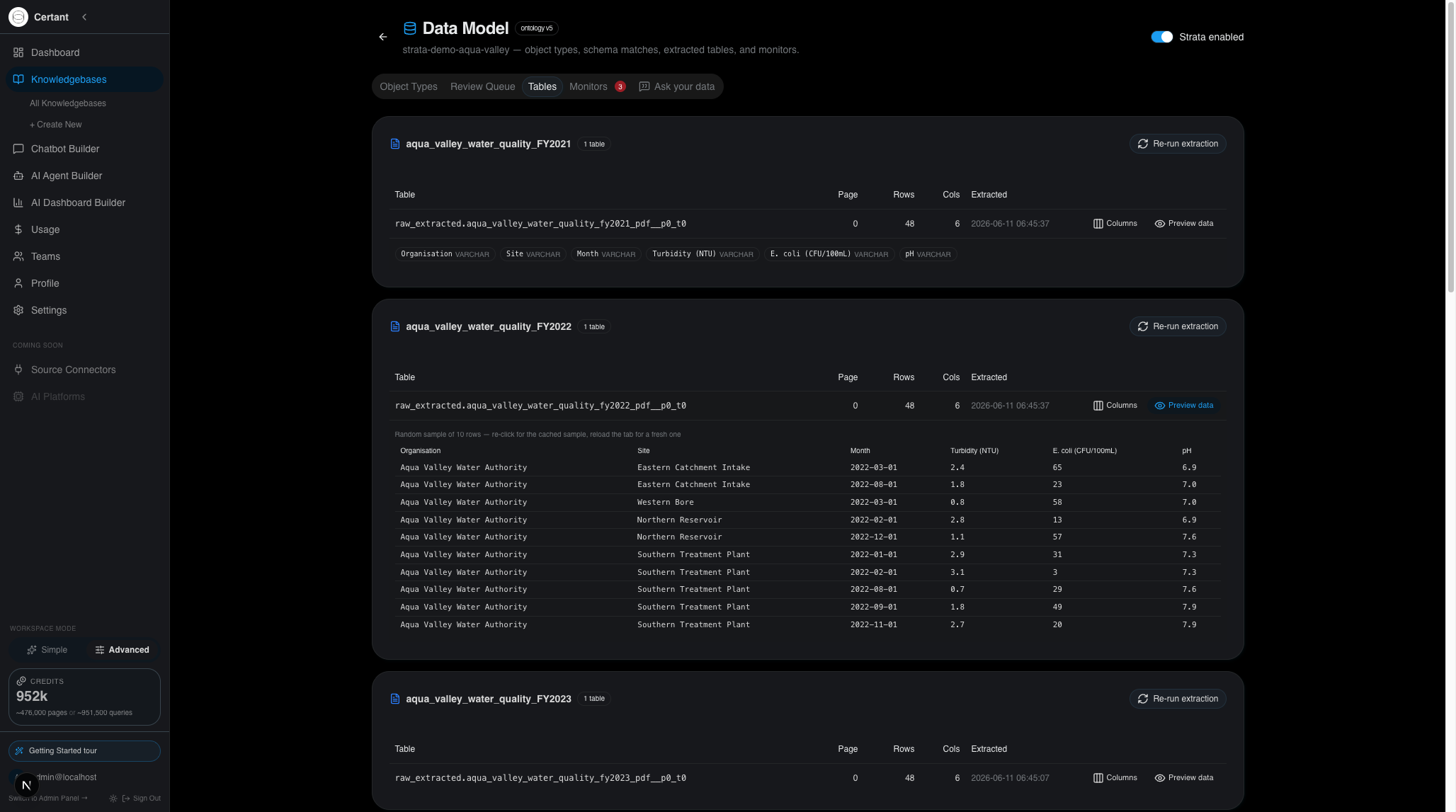
Building a knowledge graph from fragmented information is the step that turns scattered documents into something a system can reason over. It means extracting entities, relationships and rules from contracts, policies, case files and spreadsheets, then linking them so a question can be answered from the whole corpus rather than one file.

This is the work Certant was built for. The platform ingests internal documents and data, builds a live knowledge graph from them, and returns answers with citations to the source paragraph. When a staff member asks about a leave entitlement, the answer comes back with the page it came from attached. When a contract arrives, the system flags risk automatically rather than waiting for a manual read. Centralising these disparate inputs into a coherent knowledge graph ensures that every department operates from a reliable single source of truth.
Deployment matters as much as capability here. Certant supports sovereign, air-gap-capable and on-premises setups, and runs against AWS Bedrock, Azure AI, GCP Vertex or local GPUs. For organisations that had ruled out AI tools because payroll or case data could not leave the building, that changes the calculation.
Which Platform Suits Your Organisation?
Progress suits organisations whose core problem is connecting structured systems across cloud and on-premises environments. Seekr suits teams building or fine-tuning models who need clean, classified content at volume. Neither is the right answer if your staff cannot get a verifiable answer to a policy question without emailing someone.
For regulated firms, Certant is a strong fit, because it was designed around the constraints that make this category hard: traceability, sovereign deployment and answers that cite their sources. The National Institute of Standards and Technology AI Risk Management Framework is a useful reference for the governance expectations auditors increasingly apply to systems like these.
If you are still at the comparison stage, the practical test is simple. Ask each vendor to answer a real question from your own documents and show you the source. The platform that can do that is the one you need.
Frequently Asked Questions
What is the difference between Progress and Seekr for data integration?
Progress focuses on moving and connecting data between systems, including cloud and on-premises sources, through its hybrid data pipeline tooling. Seekr concentrates on turning large volumes of content into AI-ready datasets, cleaning and structuring text so models can be trained on it. One is largely a connectivity and movement layer; the other prepares content for AI consumption. Regulated firms often need both capabilities, plus a way to trace answers back to source documents.
Can Progress and Seekr integrate data from multiple sources?
Yes, both handle multiple sources, but in different ways. Progress connects databases, applications and on-premises systems so data can flow between them. Seekr ingests large content collections, such as document sets, and normalises them into training-ready form. Neither is designed specifically to produce cited, verifiable answers for staff, which is where a knowledge graph platform adds a distinct layer on top of the integration work.
What should regulated enterprises assess when comparing data integration platforms?
Start with traceability: can the platform show which source paragraph an answer came from? Then check deployment options, because sovereign or air-gapped environments rule out many cloud-only tools. Look at how contracts and policy documents are handled, whether risk flags are automatic, and how much implementation effort your existing IT team absorbs. Certant, for example, is IRAP-aligned, CPS 230 compliant and APP 8 compliant, and runs on-premises where required.
Can Progress or Seekr help create a knowledge graph from fragmented information?
Both can supply part of the picture. Progress moves and unifies data across systems, and Seekr prepares content for AI use, but neither centres on building a live knowledge graph that answers questions with citations. Certant builds that graph from internal documents and data, then returns verifiable answers pointing to the source paragraph. That matters when auditors ask how a contract clause or compliance requirement was interpreted.
The challenge is not finding a tool that moves data or prepares content. It is finding one that gives your staff an answer they can trust and prove. Certant builds a live knowledge graph from your internal documents, returns verifiable answers with citations to the source paragraph, and deploys on-premises or in an air-gapped environment when your data cannot leave the building. Start free and see what your own documents can answer.
Frequently asked questions
What is the difference between Progress and Seekr for data integration?
Progress focuses on moving and connecting data between systems, including cloud and on-premises sources, through its hybrid data pipeline tooling. Seekr concentrates on turning large volumes of content into AI-ready datasets, cleaning and structuring text so models can be trained on it. One is largely a connectivity and movement layer; the other prepares content for AI consumption. Regulated firms often need both capabilities, plus a way to trace answers back to source documents.
Can Progress and Seekr integrate data from multiple sources?
Yes, both handle multiple sources, but in different ways. Progress connects databases, applications and on-premises systems so data can flow between them. Seekr ingests large content collections, such as document sets, and normalises them into training-ready form. Neither is designed specifically to produce cited, verifiable answers for staff, which is where a knowledge graph platform adds a distinct layer on top of the integration work.
What should regulated enterprises assess when comparing data integration platforms?
Start with traceability: can the platform show which source paragraph an answer came from? Then check deployment options, because sovereign or air-gapped environments rule out many cloud-only tools. Look at how contracts and policy documents are handled, whether risk flags are automatic, and how much implementation effort your existing IT team absorbs. Certant, for example, is IRAP-aligned, CPS 230 compliant and APP 8 compliant, and runs on-premises where required.
Can Progress or Seekr help create a knowledge graph from fragmented information?
Both can supply part of the picture. Progress moves and unifies data across systems, and Seekr prepares content for AI use, but neither centres on building a live knowledge graph that answers questions with citations. Certant builds that graph from internal documents and data, then returns verifiable answers pointing to the source paragraph. That matters when auditors ask how a contract clause or compliance requirement was interpreted.